
1974 – Univac 1050-II
(Updated 23 Nov 2012)
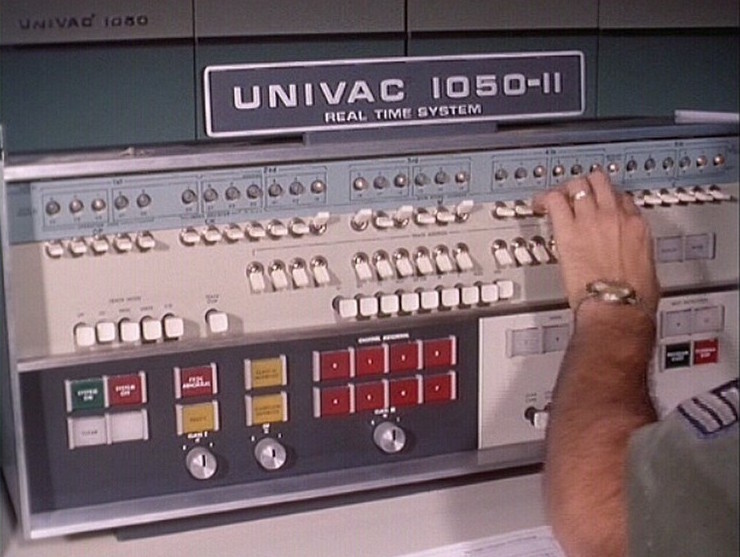
The First Computer I worked with was a UNIVAC 1050-II. It was back in 1974, while I was stationed at Myrtle Beach AFB, South Carolina. This mainframe computer used extensively by the U.S. Air Force Logistics, Base Supply System for Inventory Control. In order to even to enter training into the computer career field one first had to have attained a 5-Level in Inventory Management, which I had and therefore was able to apply for and after three months training at Lowry Air Force Base, I attain the position of Computer Operator.
In the picture the operator is reading out and altering the instructions as needed, notice the lights, on is one (1) and off is zero (o). Microprocessors perform operations using binary bits (on/off/ 1 or 0). The toggle switch below each light was used to turn the bit on or off. We did not have to read nor change the computer’s instructions very much, just when there were problems with a program or the mainframe itself.
The UNIVAC 1050 was an internally programmed computer with up to 32K of 6-bit character memory, which was introduced in 1963. It was a 1-address machine with 30-bit instructions, had a 4K operating system and was programmed in the PAL assembly language. Instructions were fixed length (30 bits = 5 characters), consisting of a 5 bit “op code“, a 3 bit index register specifier, one reserved bit, a 15 bit address, and a 6 bit “detail field” whose function varies with each instruction.
The UNIVAC 1050-II we used recorded all of its input-output on magnetic tapes (a non-volatile storage medium consisting of a magnetic coating on a thin plastic strip), and was used as a controller to format input data read from other peripherals (e.g., punch card readers). A punched card (or Hollerith card) is a recording medium for holding information for use by automated data processing machines) onto the magnetic tapes and then if required would transfer output data from the tapes to other peripherals (e.g., punch card punches or the lineprinter . Fragment of lineprinter cylinder with the type of % The Line printer is a form of high speed impact printer in which a line of type is printed at a time.).
A version used by the U.S. Air Force, the U1050-II real-time system, had some extra peripherals. The most significant of these was the FASTRAND 1 Drum Storage Unit(magnetic drum mass storage system built by Sperry Rand Corporation for their UNIVAC 1100 series computers.). This Fastrand 1 Drum Storage can partially seen in the back left of this Operation Room.
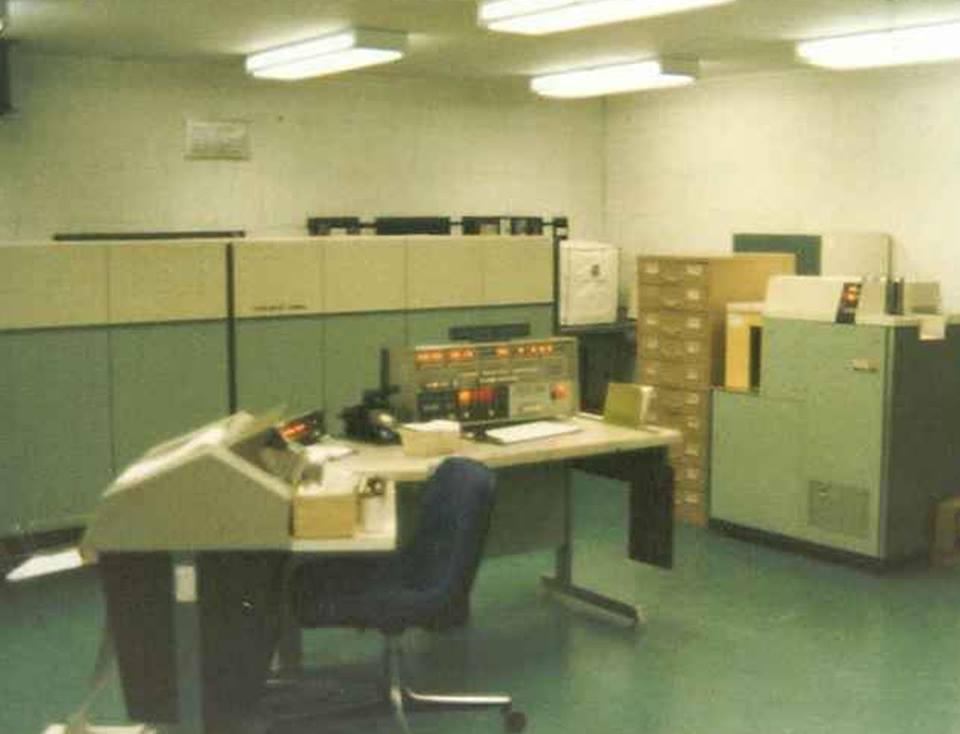
Credit for Photo : [Man in Control Room], Photograph, ca. 1960-1969; digital images, (http://texashistory.unt.edu/ark:/67531/metapth389051/ : accessed March 24, 2014), University of North Texas Libraries, The Portal to Texas History, http://texashistory.unt.edu; crediting Austin History Center, Austin Public Library, Austin, Texas. Thanks to Daniel Norton, of The Portal to Texas History, for bringing the reference to my attention (see comments below).
This physically large device had 2 contra-rotating drums mounted horizontally, one above the other in a pressurised cabinet. Read-write heads were mounted on a horizontally moving beam between the drums, driven by a voice coil servo external to the pressurised cabinet.
This high speed (for the time) access subsystem allowed the real-time operation. Another feature was the communications subsystem with modem links to remote sites. A Uniservo VI-C provided an audit trail for the transactions. Other Peripherals were the card reader and punch, and printer. The operator’s console had the ‘stop and go’ buttons(!) and a ASR33 teleprinter for communication and control.
“The UNIVAC 1050 System employs an expandable magnetic core storage capable of receiving or dispensing data at a rate of one alphanumeric character every 4.5 microseconds. Core storage is divided into modules, each having a capacity of 4096 six-bit alphanumeric characters, each of which is addressable. Core storage is character addressable (positions 0-32,767).”
(ref: http://bitsavers.informatik.uni-stuttgart.de/pdf/univac/1050/ and its linked pdf file UP-2590_1050ref_1962.pdf)
So, the Mainframe Computer’s total memory consisted of 8 memory modules, each of which had 4 kilobyte (kB) of memory capacity, which is a total of 32 kB of memory (Correction Made thanks to Steve Kovarik, see comment below). This is what we commonly refer to today as Random Access Memory, or RAM, in our computers today. That is 0.03125 of one Megabyte (MB) RAM for this mainframe computer, which was used to run Base Supply. Inline during the day, and offline to run reports each evening.
__________
Reference Sources :
http://texashistory.unt.edu/ark:/67531/metapth389051/ “Man in the Control Room” provided by The Portal to Texas History
http://bitsavers.informatik.uni-stuttgart.de/pdf/univac/1050/ and its linked pdf file UP-2590_1050ref_1962.pdf)
http://www.statemaster.com/encyclopedia/List-of-UNIVAC-products#Computer_systems
http://en.wikipedia.org/wiki/UNIVAC
http://en.wikipedia.org/wiki/History_of_computing_hardware
__________
The Poppadillo Blog, is the blog page for the Texas Tortilla Factory website, and its stories have been written by Mike Vauthier, and Administratively Approved Authors.

__________
I worked on the Penny Counter in October of 1972 in Takhli Thailand. I was the lead that was able to send the unit back home to the Clark AFB for Christmas that year. I any one has any photos of that deployment I would really appreciate them.
Thanks Gerry Baker CMS(ret)
Thanks Daniel. You are correct in your identification of the Univac 1050-II with the FASTRAND II drum. It is in the cabinet behind the tape drive. Thanks for adding to the history of this “Work Horse” it provided many years of service to the USAF.
The Austin Historical Society has recently published photos from the former Bergstrom Air Force Base. Among the photos are a computer room with what I have identified as a Univac 1050-II with a FASTRAND II drum. http://texashistory.unt.edu/ark:/67531/metapth389051/
I worked on the Univac 1050-II (Penny Counter) at Lakenheath RAFB , UK. I was part of the first team to be with the U1050 stationed there. I stayed 3 1/2 years. Arrived in 1978 , Left in 1981.. Many deployments to Europe and UK. Also worked with the U-1050 in Thailand , Richards – Gebaur , Peterson , AFA. , Seymore – Johnson Air Force Bases. Quite the experence !!
I was probably one of the last field engineers on this system back in the early 1980s. My AFSC was 305×4 and there were a group of us that were factory trained and maintained this system in the event we were needed at overseas locations. I helped pull out the system at Bergstrom AFB and helped install it’s replacement, the Unisys 1100. I was then sent to the factory school for the 1100 and went off to Dover, then Nellis. When I was at Dover, I actually had to go TDY to Turkey to work on a mobile version of the 1050 known back then as the Penny Counter. Stumbled across your page here. Nice memories.
I crossed trained as a SSgt into the x2 career field in 1968 while stationed at Bolling AFB. Worked for George Wall at that time, he was also a SSgt. Went to Pleiku VietNam from 1969-1970 and learned the system inside out. Next assignment was Cannon AFB and from there to Wright-Patterson. We had a dual system and mostly civilian operators. Went to Aviano, IT from 75-78 and was NCOIC of the 1050-II operation (ADPE/PCAM). My last base was Fairchild AFB, WA and again was NCOIC of the ADPE/PCAM Section. I retired from the AF in Oct 1983 as a MSgt. The UNIVAC 1050-II was a great computer. I was hired as a systems analyst in the Procedures Unit at Wright-Patterson and worked there until it went contract. I was transferred to the AF Security Assistance Center where I stayed until I retired in 2006. (George Wall, CMSgt Ret was well known to x2s in the day.)
I was an instructor at Lowry in the 648×0/645×2 courses from 1973-1975 and 1979-1981. I taught all the courses (asr,aar,and ast). Back in the late sixties and early seventies there was a requirement to have a 64550 AFSC to cross train into 64830 AFSC. You would get your 5 level through OJT. When they did away with 647 and 648 AFSC’s and went to the 645×0, x1, and x2 they dropped the 5 level and cross training requirement and people straight out of Basic and we really had to include more supply in the course because the job was more of a supply systems than just a computer operator, I think Mark Lumpkin left before 1974 to work with the NATO E3-A 1050-II at Geilenkirchen, I might be wrong about that. We did have another gray haired guy teaching named Woody Woodward. It was a long time ago and I may have dates mixed up. For those of you who care. I was there with Al McNair, Jim Whiteside, Carl Hayes, Greg Murphy, Roger Corum, Lynn Hughes and more the first assignment and with Larry Cagel, Larry Beauchamp, Ron Craig, Harold Phillips, Don Hansen, Ron Lemay and more the second assignment. I was active duty AF and was there for the Phase IV conversion at Plattsburgh AFB in 1985 and retired from the AF with 20 years as a SMSGT out of Torrejon AB Spain in 1987. I got a BS in Computer Science in 1988 and went to work as the Computer OPs chief in the 325th Supply Squadron at Tyndall AFB until 1996 and then a computer specialist with the Services Squadron as a civilian until 1999. I then spent the next 13 years working as an IT Specialist and Log Management Specialist for the Army in Italy (10 Years) and Fort Stewart Georgia until I retired in July 2012.
In 1965, when CBS moved into their new building at 51 W. 52nd St in NYC, a 1050 with Fastrand was installed on the 31st floor, under the direction of James Walsh, with the task of providing real-time access
to the CBS Television commercial schedule. Teletype 33 terminals
were installed at the NYC Production Center on 57th St., as well
as at the CBS Television City facility (TVC) in Los Angeles. I believe, but am not sure, that the TVC link had a dedicated line.
In any event, the Jim Walsh security feature on the TVC line was the
electrical inversion of the bit-serial signal. As far as I know, this was sufficient.
CRT terminals were supported as well, but each group of CRTs required a multi-thousand dollar controller within a few hundred feet, so
these only went to priority locations like the CBS Television Sales Department.
This was not the interactive system that we expect today, it was a
transaction system, where the user typed a transaction number
followed by an arbitrary number of fields separated by delimiter
characters. You needed a reference book to show the expected
format for each transaction. A single transaction could create
a new record, modify one or more fields of an existing record, or
print out any one of a number of reports.
Response time was usually in the five second region. Each transaction invoked a unique program, written by someone like
myself. In my two years as a programmer, I don’t recall any
major software crashes – if there was a problem, it was
usually the fault of the transaction program alone.
Terminals could not be used to enter or modify transaction programs.
They had to be punched into 80-column cards, compiled on the 1050 when it was offline, loaded onto the Fastrand, and tested by booting up the system.
We had a Fastrand II and a couple of tape drives for our daily system
backup. The Fastrand was generally reliable, but I recall a couple
of mechanical failures that required the Fastrand headbar to be manually positioned over every track (with the help of a ‘scope),
so that each track could be dumped to a tape, a tedious, hours long task.
I have no idea what our annual budget was, but in 1967 the NYC department had 12 souls. As a programmer, I was paid a bit over
$8000. per year.
There should be a detailed writeup of this pioneering application in the professional literature, but I haven’t found it to date.
BTW, there was a predecessor system installed on the 15th Floor of
the original CBS Headquarters at 4485 Madison Avenue. I worked on the same floor, but only saw the system once, and believe it was
made by Boroughs, used vacuum tubes with a mercury delay line memory,
but at the time I had no idea I would spend most of my life with my
head inside digital equipment. You would think I would have taken some pictures at least….(insert Latin motto here).
I was a Univac field engineer maintaining the 1050 from 1976 till 1983 at various Air Force bases. Have to correct an error in this article. RAM did consist of 8 core memory modules but each module was only 4KB for a total of 32KB of RAM, not 512KB.
Author added comment : Thanks Steve Correction Made with reference to core memory : http://bitsavers.informatik.uni-stuttgart.de/pdf/univac/1050/ and its linked pdf file UP-2590_1050ref_1962.pdf
Trained as an Air Force maintainer (AFSC 30574) on the 1050-II at the Univac factory in St Paul, Minnesota.
Worked on the system in Vietnam and Thailand in the late 60s and early 70s.
Forgot to include myself with Mark
Mark Lumpkin wrote and taught the 2asr programming course at Lowery in the early 70s.
Does anyone remember the old white haired civilian instructor? He taught the 3 level course.
Hi Jack what year were you at Grand Forks. I was the Univac Engineer there 81-94
Rick,
Thanks for your Comment.
Maybe for you it was not true, but for me, I was told that I had to have 5 level proficiency in Inventory Management (64550 or 65551) in order to cross train into 645X2 career field. To my understanding the level 5 proficiency would allow for better understanding of programs and reports, their distribution, and of course reports scheduling.
Best Regards
Mike
Your statement “In order to even to enter training into the computer career field one first had to have attained a 5-Level in Inventory Management” isn’t true. I was a box shepherd (x1) at Langley and cross-trained to the x2 field.
From 1977-1987 I was an operator at Cannon, Camp New Amsterdam, Grand Forks and Sembach. Then worked with USAFE with the conversion to the 1100. Retired in 1995.
Hey, Sam! I played with the monster at Shaw also. I was there from 1974-1978. Then, on to Guam, Carswell, and Las Vegas.
Damn… do I remember this monster! I “played” with this machine from 1973 until I left the AF in 1978. I “played” with it at Shaw AFB SC, McGuire AFB NJ and Bitburg Ad, Germany. The one at McGuire was a dual system setup so that the “online” system was actually online almost 24 hours a day.